Introduction: Why Progress Has Stalled Despite Advancement
Modern humanity appears advanced on the surface.
Technology accelerates. Information multiplies. Systems expand.
Yet internally, something has stagnated.
Despite innovation:
- stress increases
- social fragmentation grows
- creativity declines
- mental fatigue becomes normalized
- conflict repeats with new language
This contradiction reveals a fundamental truth:
Human systems have advanced faster than human consciousness.
The reason is not lack of intelligence.
It is habit dominance.
Human behavior is governed not by awareness, but by repeated patterns.
These patterns solidify into what can be described as mass consciousness — heavy, predictable, resistant to change.
True elevation requires breaking mass into subtlety.
That process is not achieved through addition.
It is achieved through reversal.
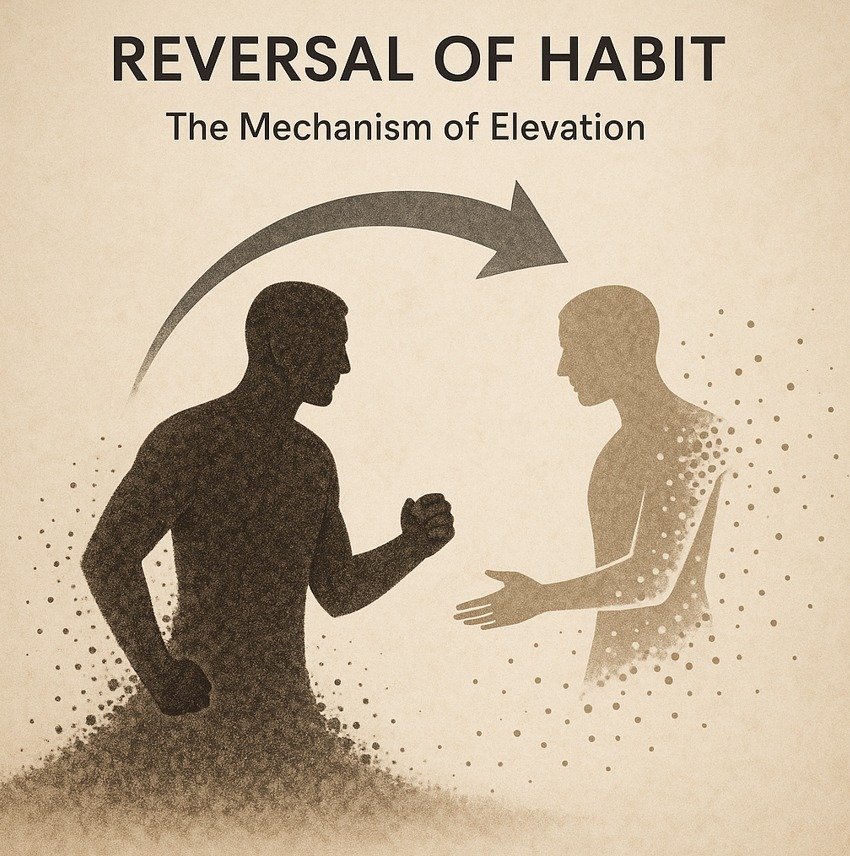
1. Habit as Mass — The Physics of Repetition
Habit is not behavior.
Habit is condensed memory.
Repeated actions, repeated thoughts, repeated emotional responses compress into stable internal structures. These structures behave like mass particles in physics:
- heavy
- inertial
- resistant to redirection
This is why people say:
“That’s just how things are.”
What they are actually describing is accumulated habit, not truth.
Habit creates comfort.
Comfort creates predictability.
Predictability creates stagnation.
Evolution requires destabilization of comfort.
2. Why Improvement Alone Does Not Create Change
Most personal and social development systems focus on improvement:
- better habits
- stronger discipline
- higher efficiency
- optimized performance
But improvement strengthens the same pattern, only faster.
If a structure is imbalanced, improving it amplifies imbalance.
Adding speed to a wrong direction does not correct direction.
It accelerates error.
This is why:
- smarter systems still collapse
- educated societies still repeat conflict
- advanced nations still operate on fear
The issue is not lack of progress.
It is lack of recalibration.
3. Reversal — The Only Mechanism That Melts Habit
Reversal is not rebellion.
Reversal is not opposition.
Reversal is counter-movement.
When a habit is practiced in the same direction repeatedly, it strengthens the same internal circuit.
When the opposite action is practiced consciously, the circuit weakens.
This is not ideology.
This is neuro-behavioral mechanics.
Reversal introduces friction.
Friction generates awareness.
Awareness dissolves rigidity.
Mass does not disappear — it melts into subtle flow.
4. Why Reversal Feels Uncomfortable (And Why That Matters)
Reversal creates internal resistance because it:
- disrupts identity
- threatens hierarchy
- removes unconscious advantage
- exposes dependency patterns
Discomfort is not failure.
Discomfort is evidence of transformation.
Habit feels natural because it is familiar.
Reversal feels abnormal because it is new to the nervous system.
Societies label reversal as:
- strange
- inappropriate
- disrespectful
- inefficient
Not because it is harmful —
but because it breaks predictability.
Predictability sustains systems.
Reversal evolves consciousness.
5. Social Habits That Maintain Imbalance
Every society carries unexamined habits that appear “normal” but function as stabilizers of imbalance:
- respecting hierarchy without questioning structure
- valuing authority over insight
- listening upward, ignoring downward
- rewarding dominance, not awareness
- celebrating speed, not sustainability
These habits are rarely questioned because they are inherited, not chosen.
Reversal challenges inheritance.
6. Example: Respect as a One-Way Habit
Many cultures emphasize respect toward elders, authority, or rank.
This produces order — but also rigidity.
What is rarely practiced:
- respecting younger voices
- listening to those without status
- learning from the inexperienced
- valuing curiosity over seniority
When someone practices bidirectional respect, society reacts with discomfort.
Why?
Because hierarchy depends on one-way flow.
Reversal dissolves hierarchy by restoring balance of attention.
Balance threatens control.
Therefore balance is labeled abnormal.
7. Reversal Is Not Disrespect — It Is Re-Alignment
Reversal does not destroy structure.
It corrects distortion.
Reversal does not reject tradition.
It tests whether tradition still serves balance.
Reversal does not deny order.
It prevents order from becoming dominance.
This is why reversal has always been the engine of:
- scientific breakthroughs
- cultural renewal
- social reform
- philosophical evolution
Every leap forward occurred when someone practiced the opposite of what was normalized.
8. From Macro Consciousness to Micro Awareness
Habitual living operates at a macro level:
- visible behavior
- surface reaction
- automatic response
Reversal activates micro awareness:
- internal observation
- subtle sensing
- delayed reaction
- conscious choice
Macro consciousness repeats.
Micro consciousness transforms.
Elevation is not about doing more.
It is about doing differently.
9. Why Society Resists Reversal
Society is structured to reward compliance, not recalibration.
Reversal threatens:
- efficiency metrics
- power stability
- social predictability
- economic momentum
Systems are optimized for repetition.
Reversal introduces uncertainty.
But evolution has never come from certainty.
It has always come from disruption of certainty.
10. Reversal as a Daily Practice (Not a Belief)
Reversal is not a philosophy.
It is a practice.
Examples:
- listening when the habit is to speak
- slowing when urgency dominates
- observing when reaction is expected
- respecting overlooked voices
- pausing before defending identity
Each reversal weakens old patterns and releases subtle intelligence.
This is how consciousness regains flexibility.
11. Reversal vs Opposition
Opposition fights the system.
Reversal bypasses it.
Opposition creates conflict.
Reversal creates recalibration.
Opposition hardens identity.
Reversal dissolves it.
This is why reversal is quiet, not loud.
Subtle, not aggressive.
Effective, not dramatic.
12. Why Reversal Is Essential for the Next Phase of Humanity
Humanity’s next challenge is not survival.
It is sustainability of consciousness.
Without reversal:
- intelligence accelerates imbalance
- technology amplifies harm
- leadership creates dependency
- society burns faster than it heals
Reversal slows destruction without stopping progress.
It introduces stability into movement.
13. The Language Shift Required
Old moral binaries:
- good / bad
- right / wrong
- superior / inferior
These polarize perception.
Reversal demands energy-based language:
- balanced / imbalanced
- rigid / flexible
- saturated / receptive
- heavy / subtle
Language shapes perception.
Perception shapes action.
Action shapes reality.
14. Reversal Is Not Optional — It Is Inevitable
If reversal is not practiced consciously,
it will be enforced unconsciously through:
- burnout
- crisis
- collapse
- forced slowdown
Nature always restores balance.
The question is whether humanity participates willingly or through consequence.
15. Conclusion — The Core Law of Elevation
Repetition creates mass.
Reversal creates elevation.
This is not morality.
This is not belief.
This is mechanics of consciousness.
Elevation does not come from adding more.
It comes from undoing what no longer serves balance.
The future will not be built by those who perfect habit,
but by those who reverse it consciously.
Reversal is the doorway.
Subtlety is the path.
Balance is the outcome.
This is not a theory.
It is the physics of human evolution.