A Structural Framework for Stability in Human, Institutional, and Systemic Design
1. Introduction: Why Pressure Is Misunderstood
Modern societies speak constantly about pressure—work pressure, economic pressure, performance pressure, emotional pressure. Yet most conversations treat pressure as either something to be eliminated or something to endure.
Both approaches are incomplete.
Pressure is not the problem.
Imbalance is the problem.
Pressure becomes destructive only when force is applied to mass without calibration.
Pressure becomes ineffective when force is absent entirely.
This article presents a neutral, structural framework for understanding pressure through the relationship between force, mass, imbalance, and balance, applicable across:
- Human nervous systems
- Workplaces and institutions
- Education and governance
- Economic and environmental systems
This is not a motivational model, a psychological theory, or a moral argument.
It is a system-design perspective.
2. The Core Conceptual Equation (Corrected)
At the center of this framework is a directional relationship, not a mathematical formula.
Correct Conceptual Flow
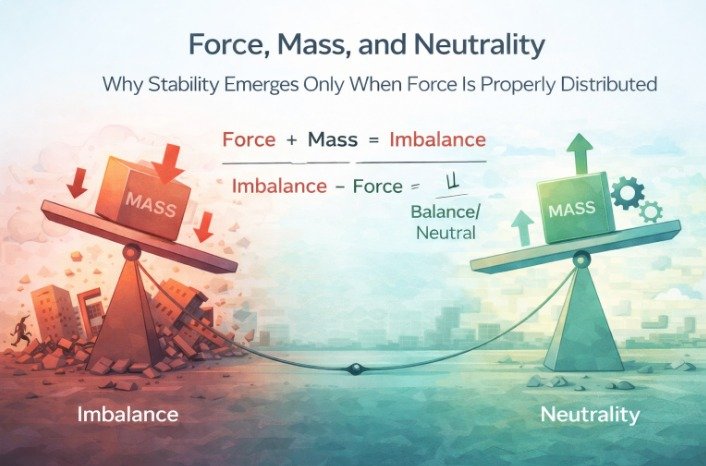
Force + Mass → Imbalance
Imbalance − Excess Force → Balance / Neutral
This sequence matters.
- Balance is not created by adding force
- Neutral is not the absence of mass
- Stability is achieved by regulating force, not removing responsibility
Any reversal of this order leads to misinterpretation.
3. Definitions (Neutral, Non-Moral)
To avoid confusion, each term is defined structurally, not emotionally.
Force
Any applied demand, pressure, expectation, speed, authority, or load.
Examples:
- Deadlines
- Productivity targets
- Physical effort
- Cognitive demand
- Social or hierarchical pressure
Force is necessary.
Mass
The system receiving force.
Examples:
- A human body
- A worker
- A team
- A machine
- An institution
- An ecosystem
Mass has limits, capacity, and recovery requirements.
Imbalance
A state where applied force exceeds the processing capacity of the mass.
Imbalance is not failure.
It is a signal.
Balance / Neutral
A calibrated state where force and mass are aligned.
Neutral does not mean:
- Zero pressure
- Absence of responsibility
- Passivity
Neutral means:
- Force is present
- Mass is respected
- Recovery exists
- Feedback flows
4. Why Force + Mass Creates Imbalance
When force is applied to mass, imbalance is inevitable unless regulation exists.
This is not a flaw. It is physics, biology, and systems logic.
Examples:
- Excess workload on a human nervous system
- Excess stacking weight on structural material
- Excess policy pressure on social systems
- Excess speed on decision-making
Imbalance occurs before collapse, not after.
Ignoring imbalance does not remove it—it compounds it.
5. The Critical Correction: Balance Is Not Created by Adding Force
A common institutional error is the belief that:
“More force will correct imbalance.”
In reality:
- More force amplifies imbalance
- More force reduces margin
- More force suppresses feedback
Balance is restored only when excess force is removed or redistributed.
That is why the correct relationship is:
Imbalance − Excess Force → Balance / Neutral
Not the reverse.
6. The Three Operational States of Pressure
Using the corrected equation, systems operate in three distinct states.
State 1: Overforce (Negative Imbalance)
Force + Mass → Imbalance (Uncorrected)
Characteristics:
- Continuous urgency
- No recovery window
- Fear-based compliance
- Suppressed reporting
- Normalized risk
Human impact:
- Survival mode
- Reduced cognition
- Increased error
- Emotional numbing
Institutional impact:
- Accidents normalized
- Ethics bypassed
- Turnover increases
- Collapse delayed, not prevented
Overforce is often mistaken for productivity.
State 2: Neutral Balance (Stable Alignment)
Imbalance − Excess Force → Balance
Characteristics:
- Force exists, but is regulated
- Recovery is built in
- Feedback is welcomed
- Errors are corrected early
Human impact:
- Clear thinking
- Ethical awareness
- Sustainable effort
Institutional impact:
- Safety improves
- Quality stabilizes
- Trust develops
- Longevity increases
Neutral balance is not comfortable—it is functional.
State 3: Force Absence (Positive Imbalance)
Mass − Meaningful Force → Drift
Characteristics:
- No challenge
- No accountability
- No corrective pressure
Human impact:
- Skill decay
- Loss of alertness
- Disconnection
Institutional impact:
- Stagnation
- Inefficiency
- Entitlement
Force absence is not peace—it is decay.
7. Why Humans and Institutions Misread Neutral
Neutral balance is often misunderstood because it satisfies neither extreme.
- It does not reward domination
- It does not indulge avoidance
Neutral requires:
- Restraint
- Awareness
- Responsibility
- Continuous calibration
This is why neutral systems are rare.
8. Pressure Miscalibration in Workplaces
In many workplaces, imbalance persists because:
- Force is increased to meet targets
- Mass capacity is assumed infinite
- Feedback is labeled resistance
- Silence is treated as agreement
Over time:
- Unsafe practices normalize
- New participants are blamed for noticing risk
- Imbalance becomes “how things are done”
This is structural, not personal.
9. The Role of Safety and Risk
Risk is not created suddenly.
It accumulates through ignored imbalance.
Examples:
- Excess height stacking
- Ignoring surface conditions
- Equipment used beyond design
- Speed prioritized over margin
When imbalance is normalized, warning signals are dismissed.
10. Silence Is Not Stability
In overforce environments, silence usually means:
- Energy conservation
- Fear of consequence
- Learned helplessness
Silence is often misread as resilience.
It is not.
11. Withdrawal as Regulation, Not Failure
When imbalance remains uncorrected, systems force individuals to self-regulate by:
- Suppressing awareness
- Exiting the environment
- Burning out
Leaving an overforce environment is often a stabilizing response, not avoidance.
12. Institutions and the Cost of Ignoring Balance
Uncorrected imbalance leads to:
- High turnover
- Training loss
- Liability exposure
- Cultural erosion
Short-term gains are offset by long-term instability.
13. Neutral Intelligence: A Design Lens
Neutral intelligence is the capacity to assess:
- Actual force applied
- Actual mass capacity
- Recovery requirements
- Feedback suppression
It removes moral judgment and focuses on structure.
14. Pressure Transfer Across Systems
Unresolved pressure does not disappear.
It transfers:
- From workplace to home
- From institutions to individuals
- From present to future
Balanced systems absorb pressure.
Imbalanced systems export it.
15. Global Context
Economic contraction, climate stress, and social instability are amplifying force globally.
Systems built for abundance are now operating under constraint.
More force will not solve force-induced imbalance.
16. Why Correction Fails Without Calibration
Replacing tools, people, or policies without recalibrating force:
- Moves imbalance elsewhere
- Repeats failure in new form
Correction without balance is cosmetic.
17. Ethics and Pressure
Ethics collapse under overforce because fear overrides judgment.
Ethics decay under force absence because responsibility disappears.
Only neutral balance sustains ethics.
18. Language Matters
Terms like “weak,” “lazy,” or “resistant” block correction.
Neutral language enables assessment:
- Overloaded
- Misaligned
- Under-resourced
Language shapes response.
19. From Endurance to Alignment
Endurance culture glorifies survival under imbalance.
Alignment culture designs for sustainability.
The future belongs to aligned systems.
20. Conclusion: Stability Is an Active Process
Pressure is unavoidable.
What matters is how force is applied to mass and how imbalance is corrected.
- Force + Mass → Imbalance
- Imbalance − Excess Force → Balance / Neutral
Neutral balance is not passive.
It is continuous calibration.
Systems that survive longest are not the fastest or the harshest—but the most balanced.