Why Systems Break When Signals Are Ignored
1. Introduction: The Hidden Failure Point in Human Systems
Most breakdowns in relationships, organizations, and institutions are commonly attributed to disagreement, conflict, or difference of values. These explanations are incomplete.
Systems rarely fail because people disagree.
They fail because signals are not acknowledged.
Acknowledgment is not agreement.
Acknowledgment is not validation.
Acknowledgment is not submission.
Acknowledgment is a structural function that allows communication systems to remain coherent.
When acknowledgment is absent, systems destabilize — regardless of intention, ethics, or goodwill.
This article examines acknowledgment not as a personal virtue, but as a functional requirement for stability in human and institutional systems.
2. What Is Acknowledgment (and What It Is Not)
Acknowledgment is often misunderstood as emotional approval or moral alignment. This misunderstanding leads to its avoidance.
Acknowledgment means:
- Recognizing that a signal has been received
- Confirming that input exists
- Allowing the signal to complete its transmission
Acknowledgment does not mean:
- Agreement with the content
- Acceptance of the conclusion
- Endorsement of the position
- Obligation to comply
A system can acknowledge a signal and still disagree, reject, or modify it.
What matters is that the signal is not erased.
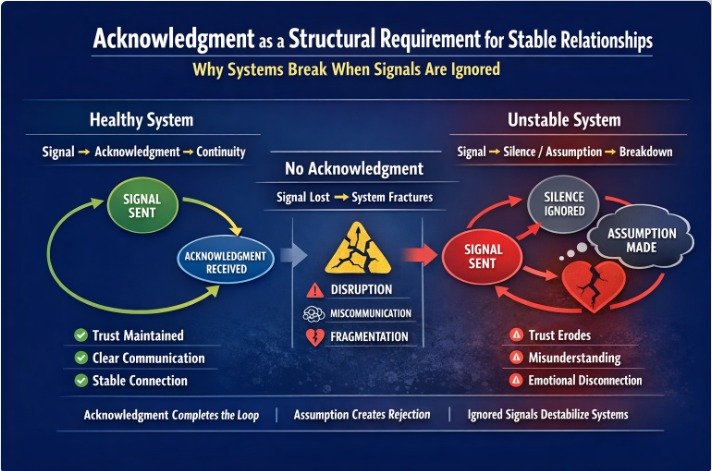
3. Signal → Acknowledgment → Continuity
All stable systems operate on a simple loop:
Signal → Acknowledgment → Continuity
- A signal is expressed
- The signal is acknowledged
- The system remains coherent
When acknowledgment is missing, the loop breaks:
Signal → Silence / Overlap → Instability
Silence, assumption, or interruption functions as signal loss, not neutrality.
4. Assumption as Functional Rejection
Assumption is often mistaken for understanding.
In reality, assumption is a structural override.
When a system replaces an incoming signal with its own interpretation before acknowledgment, it performs an implicit rejection.
This occurs when:
- Responses are formed before listening completes
- Interpretation is layered over expression
- Meaning is inferred instead of received
Assumption does not require hostility to cause damage.
It destabilizes systems through premature substitution.
5. Why Assumption Feels Like Rejection
From a systems perspective, assumption interrupts transmission.
From a relational perspective, this interruption is experienced as rejection because:
- The original signal is not held
- The sender’s expression is displaced
- The system prioritizes internal projection over external input
Even well-intended assumption collapses trust, because the system no longer reflects accurately.
6. Acknowledgment vs Agreement: A Critical Distinction
Many systems avoid acknowledgment because they confuse it with agreement.
This creates a false dilemma:
- “If I acknowledge, I must agree”
- “If I don’t agree, I must not acknowledge”
This is structurally incorrect.
Healthy systems acknowledge first, then decide.
Without acknowledgment:
- Dialogue becomes collision
- Difference becomes dominance
- Communication becomes competition
7. Interruption as Structural Noise
Interruption is not merely impolite.
It is systemic noise.
Interruption:
- Prevents signal completion
- Forces compression of meaning
- Introduces defensive reaction
In high-pressure environments, interruption becomes normalized, creating:
- Shallow exchanges
- Escalating misunderstandings
- Emotional overload
Systems that normalize interruption cannot sustain clarity.
8. Silence Is Not Always Neutral
Silence is often framed as restraint or peace.
Structurally, silence has multiple meanings.
Silence can indicate:
- Reflection
- Pause
- Processing
But silence can also indicate:
- Avoidance
- Suppression
- Withdrawal of acknowledgment
When silence replaces acknowledgment consistently, systems degrade without visible conflict.
9. Acknowledgment and Emotional Load
Unacknowledged signals do not disappear.
They convert into:
- Internal pressure
- Emotional residue
- Defensive behavior
This pressure migrates across systems:
- From conversation to mood
- From mood to behavior
- From behavior to environment
Acknowledgment releases pressure without requiring resolution.
10. Why Systems Resist Acknowledgment
Systems resist acknowledgment because it:
- Slows response time
- Requires presence
- Interrupts hierarchy
- Exposes misalignment
In rigid systems, acknowledgment is perceived as loss of control.
In reality, lack of acknowledgment is what causes loss of control.
11. Acknowledgment in Families
In family systems:
- Assumption replaces listening
- Roles override presence
- Emotional hierarchy blocks acknowledgment
This creates cycles of:
- Repetition
- Escalation
- Withdrawal
Families stabilize not by agreement, but by acknowledged difference.
12. Acknowledgment in Workplaces
In organizations:
- Speed is prioritized over clarity
- Feedback is filtered upward
- Risk signals are ignored
Unacknowledged warnings become:
- Incidents
- Attrition
- Liability
Organizations that acknowledge early signals reduce failure without increasing conflict.
13. Acknowledgment in Institutions and Governance
Institutions collapse trust when:
- Public signals are acknowledged symbolically but ignored functionally
- Feedback mechanisms exist but are not acted upon
- Listening is performed without response
Acknowledgment without follow-through is perceived as manipulation.
14. Why Acknowledgment Is Not Emotional Dependency
Acknowledgment does not require emotional merging.
It requires:
- Attention
- Recognition
- Completion of transmission
It preserves autonomy on both sides.
15. Neutral Acknowledgment as Design Principle
Neutral acknowledgment can be designed into systems through:
- Turn-taking protocols
- Response windows
- Signal confirmation mechanisms
- Non-evaluative listening stages
This applies to:
- Human dialogue
- Organizational processes
- Human–AI interaction
16. Acknowledgment and AI–Human Systems
In AI-mediated environments:
- Overlapping interpretation creates distortion
- Premature inference erodes trust
AI systems must distinguish between:
- Receiving a signal
- Interpreting a signal
- Responding to a signal
Acknowledgment must precede interpretation.
17. The Cost of Ignoring Acknowledgment
When acknowledgment is absent:
- Systems harden
- Individuals withdraw
- Complexity increases
- Correction becomes expensive
Most crises originate not from disagreement, but from ignored signals.
18. Acknowledgment as Preventive Stability
Acknowledgment:
- Reduces emotional load
- Preserves system coherence
- Prevents escalation
- Enables difference
It is not conflict resolution.
It is conflict prevention.
19. Reframing Strength
Strength is often defined as endurance or dominance.
Structurally, strength is:
- The ability to receive signals without distortion
- The capacity to hold difference without collapse
Acknowledgment is strength.
20. Conclusion: Continuity Depends on Acknowledgment
Stable systems do not require agreement, sameness, or silence.
They require acknowledgment.
Where acknowledgment exists:
- Dialogue survives difference
- Pressure dissipates
- Trust remains possible
Where acknowledgment is absent:
- Assumption replaces understanding
- Silence replaces connection
- Systems fragment quietly
Acknowledgment is not optional.
It is a structural requirement for continuity.