Why Systems Collapse When Pressure Is Misapplied
1. Introduction: Pressure Is Not the Problem
Pressure is a natural force.
It exists in physics, biology, economics, engineering, and human organization. Without pressure, no system moves, adapts, or evolves.
However, pressure becomes destructive when it is misapplied, miscalibrated, or exceeds the processing capacity of the system receiving it.
Modern systems frequently treat pressure as a universal solution:
- More pressure to increase productivity
- More pressure to enforce compliance
- More pressure to accelerate outcomes
This assumption is flawed.
Pressure does not automatically produce strength.
It produces response — and response quality depends entirely on load, capacity, and recovery.
The failure of many institutions, workplaces, and organizations does not originate from a lack of effort or discipline. It originates from pressure imbalance.
This article examines pressure as a structural variable — not a moral one — and explains why systems collapse when pressure is applied without regard to capacity, context, or recovery.
2. Force, Load, and Capacity
In any functional system, three variables determine stability:
- Force – the demand applied
- Load – the weight or responsibility carried
- Capacity – the system’s ability to process, adapt, and recover
When force exceeds capacity, imbalance occurs.
Importantly, capacity is not static. It fluctuates based on:
- Environment
- Experience
- Recovery time
- Cognitive and physical limits
- System design
Applying force without accounting for these variables creates the illusion of strength while quietly degrading stability.
A system may continue to function under excess force — but it does so by suppressing feedback, narrowing awareness, and accepting hidden risk.
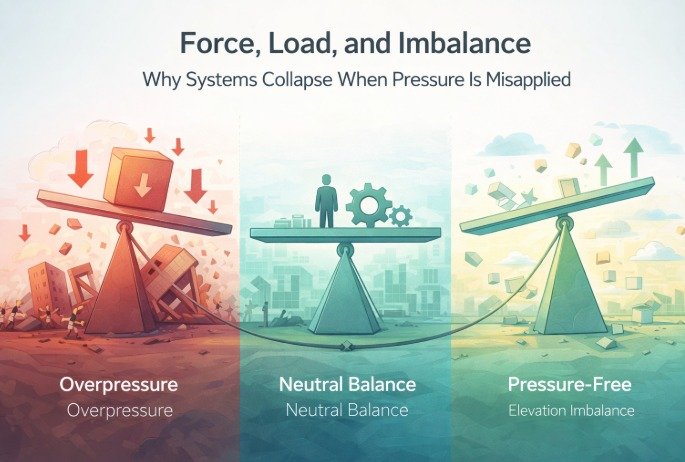
3. The Three Pressure States (Structural View)
All systems operate within three distinct pressure states. These states are not theoretical; they are observable across industries, institutions, and environments.
3.1 Overpressure State — Gravity Overload
This occurs when force is applied beyond capacity for prolonged periods.
Characteristics:
- Compressed timelines
- Continuous urgency
- Reduced margin for error
- Suppressed reporting
- Fear-based compliance
Systems in this state rely on endurance rather than design.
Short-term output may appear high, but internal degradation accelerates. Errors increase, safety margins shrink, and corrective signals are ignored.
Overpressure does not strengthen systems.
It hides weakness until failure becomes unavoidable.
3.2 Balanced Pressure State — Neutral Stability
This is the only sustainable operating zone.
Characteristics:
- Clear responsibility aligned with capacity
- Time for observation, decision, and action
- Recovery built into structure
- Feedback encouraged and acted upon
- Errors treated as signals, not threats
Balanced pressure allows systems to remain responsive without collapsing.
Stability emerges not from force, but from alignment.
3.3 Pressure-Free State — Elevation Imbalance
Pressure-free environments are often misunderstood as ideal.
Characteristics:
- Absence of responsibility
- No corrective force
- Minimal engagement
- Drift without direction
While this state may feel calm, it lacks structural integrity.
Systems in pressure-free conditions stagnate. Skills decay, awareness dulls, and accountability dissolves.
Pressure-free is not balance.
It is passive imbalance.
4. Overpressure and Institutional Normalization
Overpressure rarely appears suddenly. It develops gradually through normalization.
Common patterns include:
- Temporary shortcuts becoming permanent practices
- Increased stacking, speed, or load justified by efficiency
- Environmental risks discounted as “routine”
- New participants expected to adapt rather than question
Over time, unsafe conditions become invisible.
This phenomenon is known in safety science as normalization of deviance — where deviation from safe design becomes accepted because failure has not yet occurred.
When imbalance persists long enough, it becomes muscle memory at the system level.
5. Ground-Level Proactive vs System-Level Proactive
A critical distinction often overlooked is the difference between ground-level proactive behavior and system-level proactive behavior.
Ground-Level Proactive
- Situational awareness
- Human judgment
- Adaptive response
- Context-sensitive decision-making
System-Level Proactive
- Continuous operation
- Machine-paced execution
- Fixed procedures
- Limited flexibility
Confusing these two creates risk.
When systems demand machine-level consistency from human operators without allowing ground-level adjustment, imbalance occurs.
Human beings are adaptive systems, not constant-output machines.
6. Workplace Incidents as Pressure Signals
Many workplace incidents are not accidents.
They are signals — delayed expressions of accumulated imbalance.
Common indicators:
- Excessive stacking or height beyond design limits
- Environmental conditions ignored (weather, surface, visibility)
- Equipment used outside intended scope
- Speed prioritized over safety margin
When such signals are dismissed as normal, systems drift further from stability.
Incidents appear sudden only because warnings were ignored.
7. Silence, Compliance, and Survival Behavior
In overpressurized systems, silence increases.
This silence is often misinterpreted as agreement or competence. In reality, it often indicates:
- Risk fatigue
- Fear of reprisal
- Learned helplessness
- Energy conservation
Silence is not stability.
It is a survival response.
Systems that rely on silence are already unstable.
8. Why Strength Is Misdefined
Modern culture often equates strength with endurance under pressure.
This is a misunderstanding.
Endurance measures tolerance, not sustainability.
True strength lies in:
- Maintaining clarity under load
- Preserving judgment under demand
- Protecting recovery while remaining productive
A system that requires constant strain to function is not strong.
It is fragile.
9. Institutional Cost of Imbalance
The costs of overpressure are not eliminated — they are transferred.
Common outcomes:
- High turnover
- Increased injury rates
- Training loss
- Legal exposure
- Cultural erosion
Short-term gains achieved through overpressure result in long-term instability.
This is not efficiency.
It is deferred failure.
10. Neutral Design Principles for Stability
Stable systems are designed, not enforced.
Neutral design principles include:
- Load aligned with capacity
- Environmental conditions accounted for
- Clear operational margins
- Feedback channels protected
- Recovery integrated into scheduling
Neutral design does not remove responsibility.
It distributes it intelligently.
11. Conclusion: Stability Is a Design Choice
Pressure is unavoidable.
Imbalance is optional.
Systems collapse not because people fail, but because pressure exceeds capacity without correction.
Balanced pressure enables:
- Safety
- Learning
- Retention
- Ethical operation
- Long-term continuity
The future belongs not to systems that push hardest,
but to systems that remain stable longest.