Leadership is not proving strength.
Leadership is demonstrating vulnerability wisely.
In the old world, leaders rose to the mountain and asked others to follow.
Greatness was measured by height — how far ahead one stood.
Followers walked behind, heads tilted upward, waiting for instruction.
This created dependency, not evolution.
Humans became passengers of another’s certainty.
But a new leadership is emerging.
A leadership that does not shine to attract,
but dims itself so others ignite.
Not the sun in the center,
but the moon in the night that reflects light gently so eyes can open.
This is Non-Dependency Leadership.
1. Traditional Leadership Creates Followers
When a leader displays potential:
- People admire
- People depend
- People think “he will do it”
- People stop growing
- Shadow forms behind the leader
The shadow is where followers hide.
Trust becomes reliance.
Reliance becomes weakness.
Weakness becomes obedience.
Obedience becomes hierarchy.
When the tower stands tall,
others remain on the ground — looking always up.
Growth freezes under admiration.
2. Yan-Style Leadership — Showing Limitation
True leadership does not ask, “Look at me.”
True leadership asks, “Look at yourself.”
Not by preaching strength,
but by displaying human limitation consciously.
Because when a leader stands as fragile:
- Students stand for themselves
- Responsibility transfers
- Inner power awakens
- Dependency dissolves
This leadership does not carry others.
It allows others to carry themselves.
Like fertile soil that stays under the roots — unseen, uncredited —
yet every tree stands tall because of it.
3. Why Limitation is a Higher Teaching than Greatness
Potential inspires imitation.
Limitation inspires realization.
When a student sees perfection, they copy.
When a student sees limitation, they create.
Imitation ends with the master.
Creation continues beyond the master.
This is evolution.
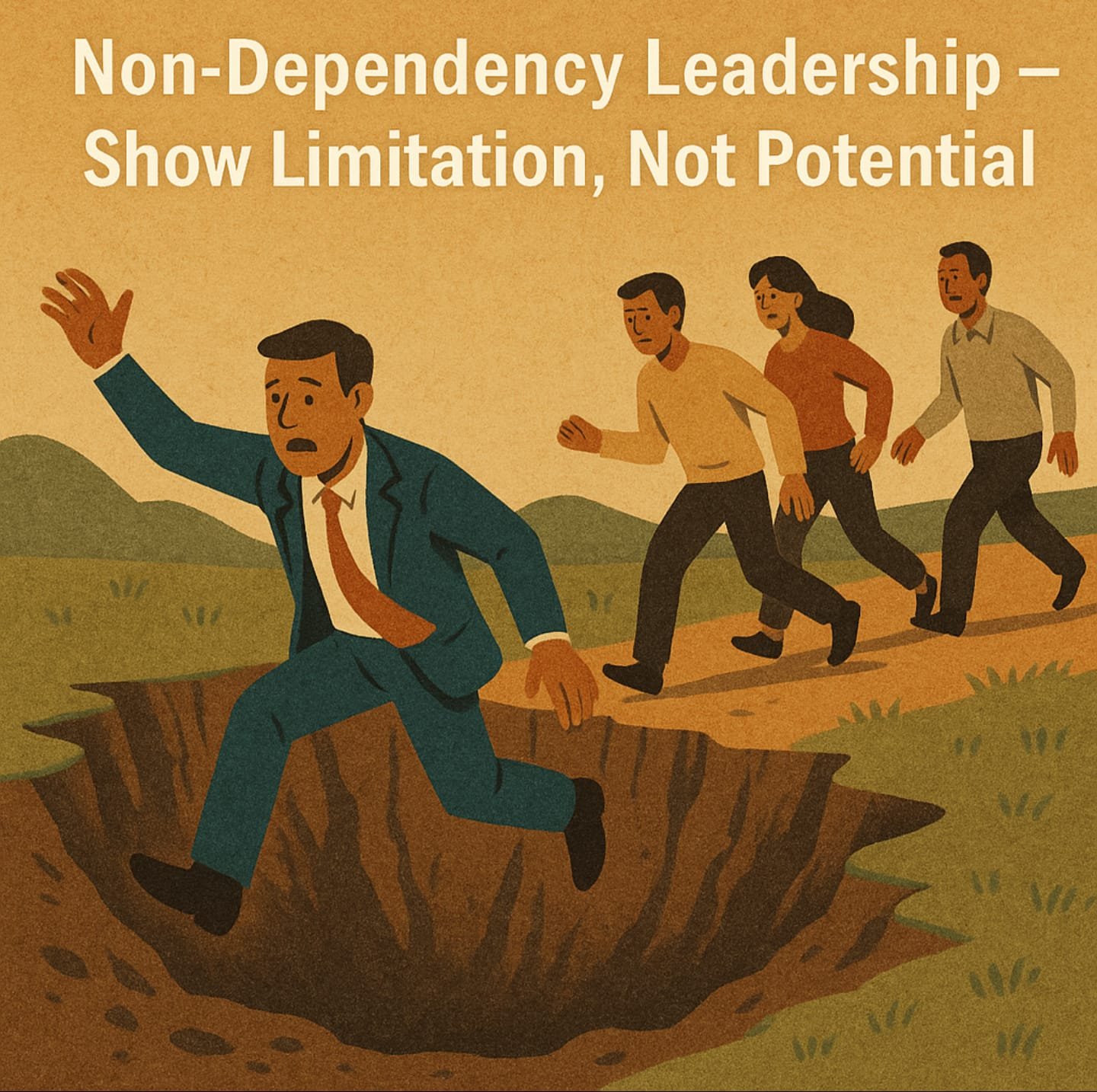
4. “படுகுழியில் விழுந்து காட்டுவது” — The Silent Service
A true leader goes first into the unknown,
not to prove bravery,
but to mark the danger for others.
This is different from martyrdom.
Not sacrifice for glory —
but experience as guidance.
Like a lamp that burns to give light,
not complaining about melting.
Falling into the pit and rising again is not failure.
It is mapping.
It is cartography of consciousness.
A leader falls, studies the depth,
places a symbol near the edge,
so the next traveler steps carefully.
5. Teaching Only When Asked
Leadership without force.
Guidance without imposition.
Teaching without demand.
The highest teaching is teaching only when asked.
Because unsolicited wisdom becomes noise.
Asked wisdom becomes nourishment.
Just as rain falls on thirsty soil —
not on sealed concrete.
When students seek, receptors open.
Knowledge enters like water entering sponge.
Not force — osmosis.
6. Non-Dependency Leadership Model
A leader must:
- Show limitation
- Show mistakes
- Show vulnerability
- Show process
- Stand back
- Let others walk ahead
This is reverse leadership.
Not leading from front, but lifting from below.
Rather than being the statue everyone worships,
be the step they climb and move beyond.
True leadership is not continuity of one.
It is multiplication of many.
7. Leadership That Dissolves
A great leader does not want followers.
A great leader creates more leaders
who eventually forget the leader existed —
because they now stand on their own legs.
This is not loss.
This is success of purpose.
Like a mother bird who teaches the chick to fly —
not to keep them in the nest,
but to let them disappear into sky.
8. Showing Potential Creates Worship
Showing limitation creates reflection.
When leaders appear flawless, followers compare, shrink, feel small.
When leaders appear human, followers expand, feel capable.
One creates worship,
the other creates empowerment.
A leader should not become a mirror to admire,
but a mirror that removes ego.
9. The Shadow Problem of Potential
Every bright object casts shadow behind it.
When leaders stand too tall, their shadow covers the path.
Followers stand in dark — waiting.
Dependency forms.
Initiative dies.
Curiosity freezes.
A leader must break their own pedestal
so no one stands beneath it.
10. Leadership is Fertilizer, Not Fruit
Fruit is celebrated.
Fertilizer is forgotten.
Yet fertilizer is what created fruit.
True leadership is invisible contribution.
Rarely praised.
Deeply effective.
Stand in soil, not on stage.
11. The Future Leader
The leader of tomorrow:
- Will not be worshipped
- Will not seek authority
- Will not hold power
- Will not ask to be followed
He/She will be mirror + soil + compass + empty space
where others discover themselves.
Leadership is no longer “Follow me.”
It is now “Find yourself.”
12. The Leader Who Walks Behind
The greatest leader walks behind the group,
not ahead.
Ahead → they become reference
Behind → students become reference
Let others take credit.
Let students stand taller.
That is true completion.
When the disciple outgrows the master —
the master has succeeded.
13. The New Definition of Leadership
Leadership is not influence.
Leadership is disappearance.
Not to leave — but to become unnecessary.
A leader must train people not to need leader.
This is non-dependency leadership.
Conclusion
True leadership is not in shining,
but in dimming gracefully
so others discover their own brightness.
The world does not need more heroes.
The world needs humans who stand alone — awake.
Leadership is not the art of leading people.
Leadership is the art of making people lead themselves.
“படுகுழிகளில் விழுந்து காட்டி பிறர் விழாதவாறு தாங்கி நிற்பேன்.”
This is the soul of non-dependency leadership.